Everyone in “New York” is trying to perform a version of themselves, and almost no one is sure which version is the real one.
Lestat is in the studio recording an album he wants to be the perfect distillation of who he is, except he doesn’t actually know who that is anymore. So he is taking it out on the drum kit, the guitar, and most of all himself. Louis is paying a young woman and her friend to perform Claudia and Madeleine, in a tableau so bleak it feels less like grief and more like community theater. Daniel is performing someone who is totally not going to give in when Armand throws him a lifeline from his sea of loneliness. Armand, meanwhile, is ready to let the Gremlin out to play.
Also: The Queen is here.

We’re getting the band back together
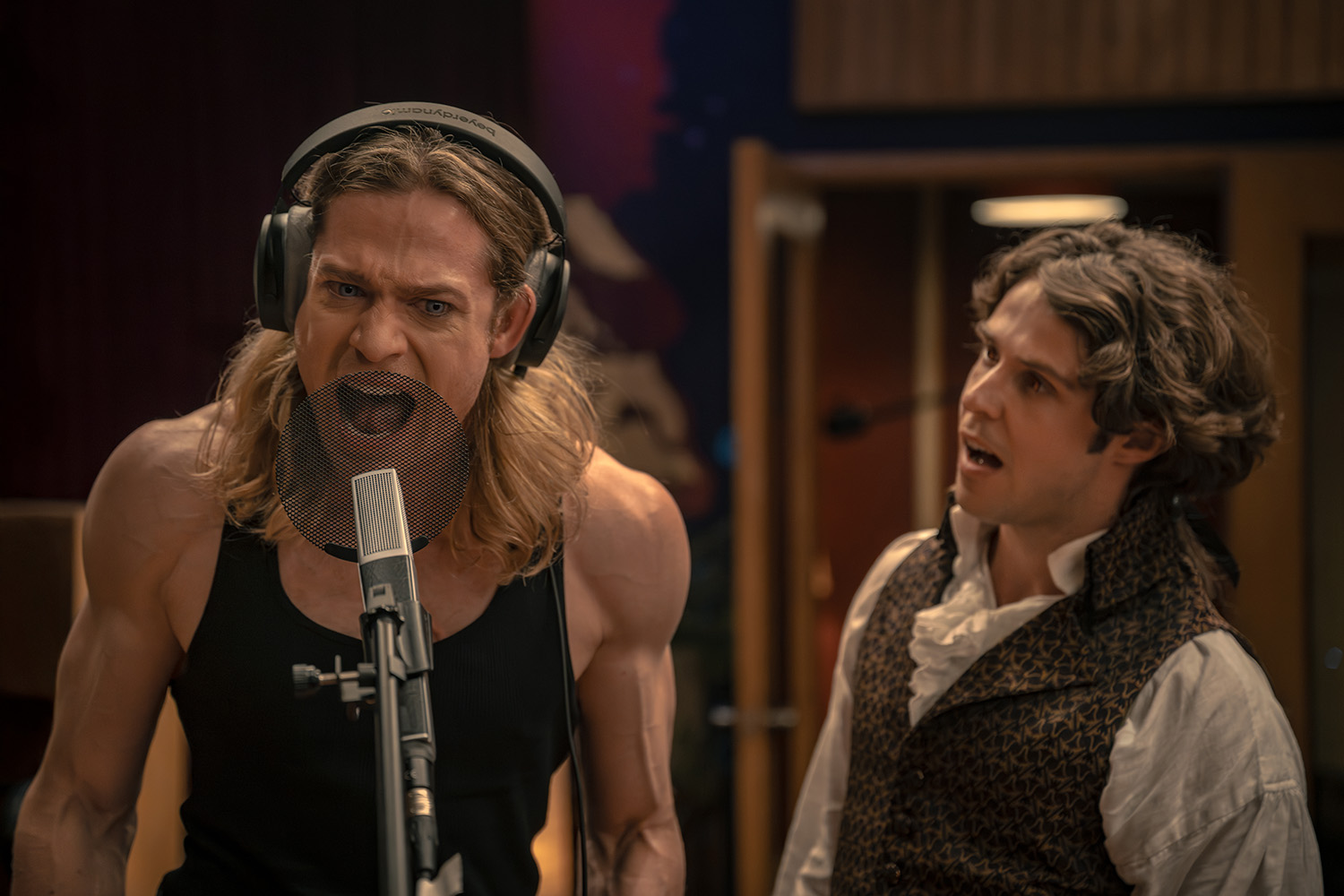
Despite now being “dead,” Lestat and his band are busy recording an album, and Lestat is taking the concept of suffering for your art to a whole new level. He wants the album to be the perfect distillation of who he is, which would be a much easier task if he had any idea who that actually is.
So instead, he is unraveling at Larry, at the drums (drums are not supposed to sound like drums, they are supposed to sound like death then life), and obsessing over his own vocal track on “Big Boss,” which he keeps insisting isn’t raw enough. What he’s really chasing is the sound of Claudia’s final scream as she died.
I don’t think Lestat has ever truly processed his grief over Claudia’s death. Instead, he’s trying to transform it into art, which has increasingly become his default coping mechanism this season. He doesn’t know what to do with his grief or his rage, so he keeps trying to compress them into the perfect song, as though getting the recording exactly right might finally exorcise something inside him. And the fact that he’s pouring all of this into “Big Boss” makes it feel like one long, eternal middle finger aimed squarely at Armand. Remember what you did when you listen to this song alone, Gremlin.
His solution? Run into the sun, burn alive, scream into a microphone, and do it all over again until he gets the take he wants. Suffering for your art has been a rock-and-roll tradition since the genre’s inception, but Lestat has launched the idea clear into the stratosphere. Sam Reid, meanwhile, is very clearly having such an unholy good time with this material.
What’s actually happening beneath the artistic tantrum is the same thing that’s been happening to Lestat all season: he’s trying to write the truth of himself in real time, without really knowing who that self is. The book got him wrong, at least in his telling. The tour didn’t fix it. He’s finished filming the documentary. So now he’s pinned everything on the next thing that might finally explain who Lestat de Lioncourt really is: the album.
Lestat’s problem, though, has never been that he just hasn’t found the right medium.
Théâtre des Fakes
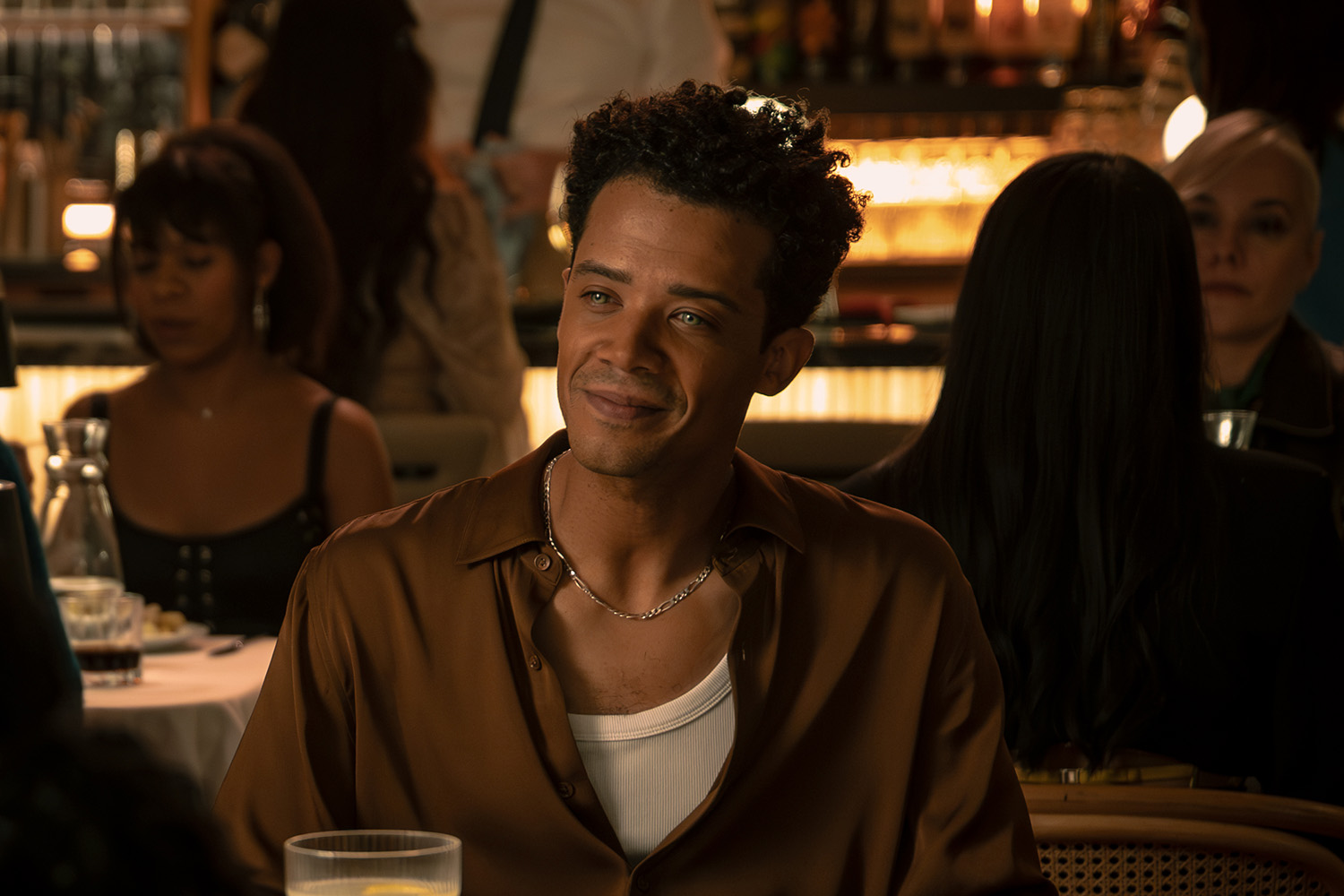
Elsewhere, Louis is also unraveling, but he’s performing his grief in very different ways. He is no longer just paying Regina to play Claudia, but has now roped in her friend, sporting a bad redhead wig (shockingly, not the worst wig of this season!), to play Madeleine.
The two perform in character for him, and you can tell there are times that Louis knows how horrifying this is, but he can’t seem to stop. Worse, he gets visibly upset whenever they break character. The illusion shatters, and he can’t bear to look at the fractured funhouse mirror version of his unholy family that he’s created.
The episode underscores this again later, when Regina and Louis sit along the riverbank. Louis tells her, “You don’t have to do the accent,” because she can’t quite get it right, only to immediately restart the scene anyway. Regina isn’t much of an improviser, and the whole exchange is painfully awkward in the kind of way that makes you want to leave the room.
Armand was not the only person in the Dubai penthouse capable of being a theatre director.
Jacob Anderson is doing truly devastating work in these scenes, and that’s on top of an all-timer performance over the last two seasons. Louis has chosen his grief over everything else: over Lestat, over revenge, over moving on, even over reality itself.
Marius and Those Who Must Be Kept
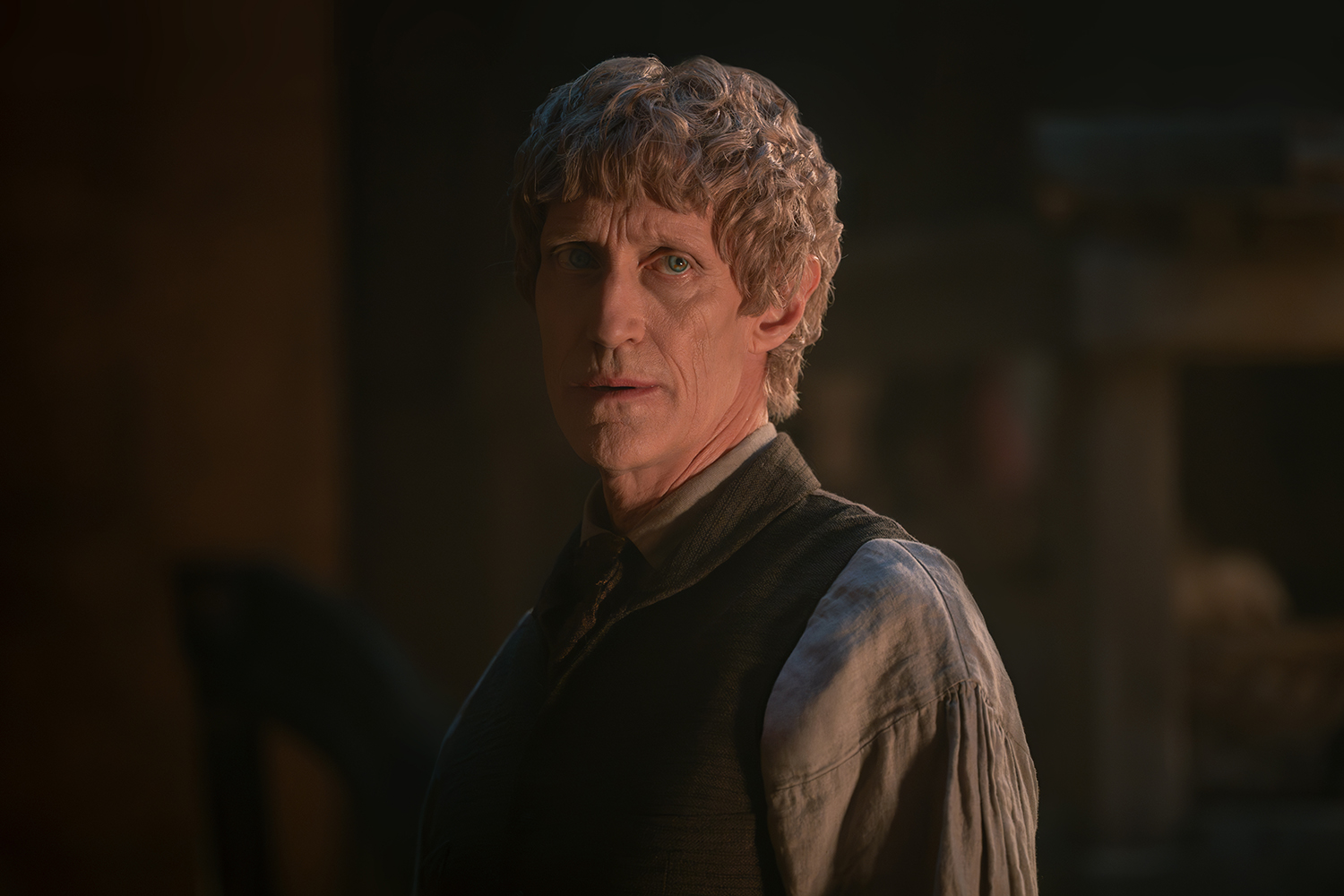
Much of this hour is spent in a flashback, when we finally meet Marius.
This is the part book readers have either been cheering for or bracing for, and the show handles his introduction with the appropriate mixture of reverence and side-eye (and mostly I feel it’s the latter, for which I am personally grateful, but Marius has plenty of book fans and he was a favorite of Anne Rice — and if you are my #1 Marius defender friend, I am truly sorry for some of the words I am about to say).
Marius is Armand’s maker — the same Marius who loaned him out to friends for sex, who let Armand believe he was dead for centuries, and who, upon his return to the screen, still describes Armand as a “rotten boy.” Sure, Marius. Sure.
What Marius is doing in the flashback is keeping watch over Those Who Must Be Kept, the ancient Akasha and Enkil, the first and original vampires, currently in what amounts to a millennia-long deep sleep (though it’s unclear if Enkil is asleep at this point or just… dead).
Essentially, they are statues now, having been still for so long, and the entire vampire population of Earth is dependent upon whether at least Akasha continues to be a statue. If they burn, everyone burns. It is one of those existential housekeeping responsibilities you don’t really hear about until somebody decides to wake them up.
Marius has woken Lestat from his own eighty-year dirt nap to help keep an eye on them. He claims Akasha chose Lestat for the role, but another reading is that he is simply looking for a babysitter so he can take a vacation. Marius contains multitudes.
And Akasha, for her part and though still “asleep”, is clearly as big a fan of Marius as I am, as when Marius explains to Lestat she didn’t say anything to him for the first 22 years, she whispers immediately in Lestat’s head that it was actually 23.
Drag him, queen.
Akasha
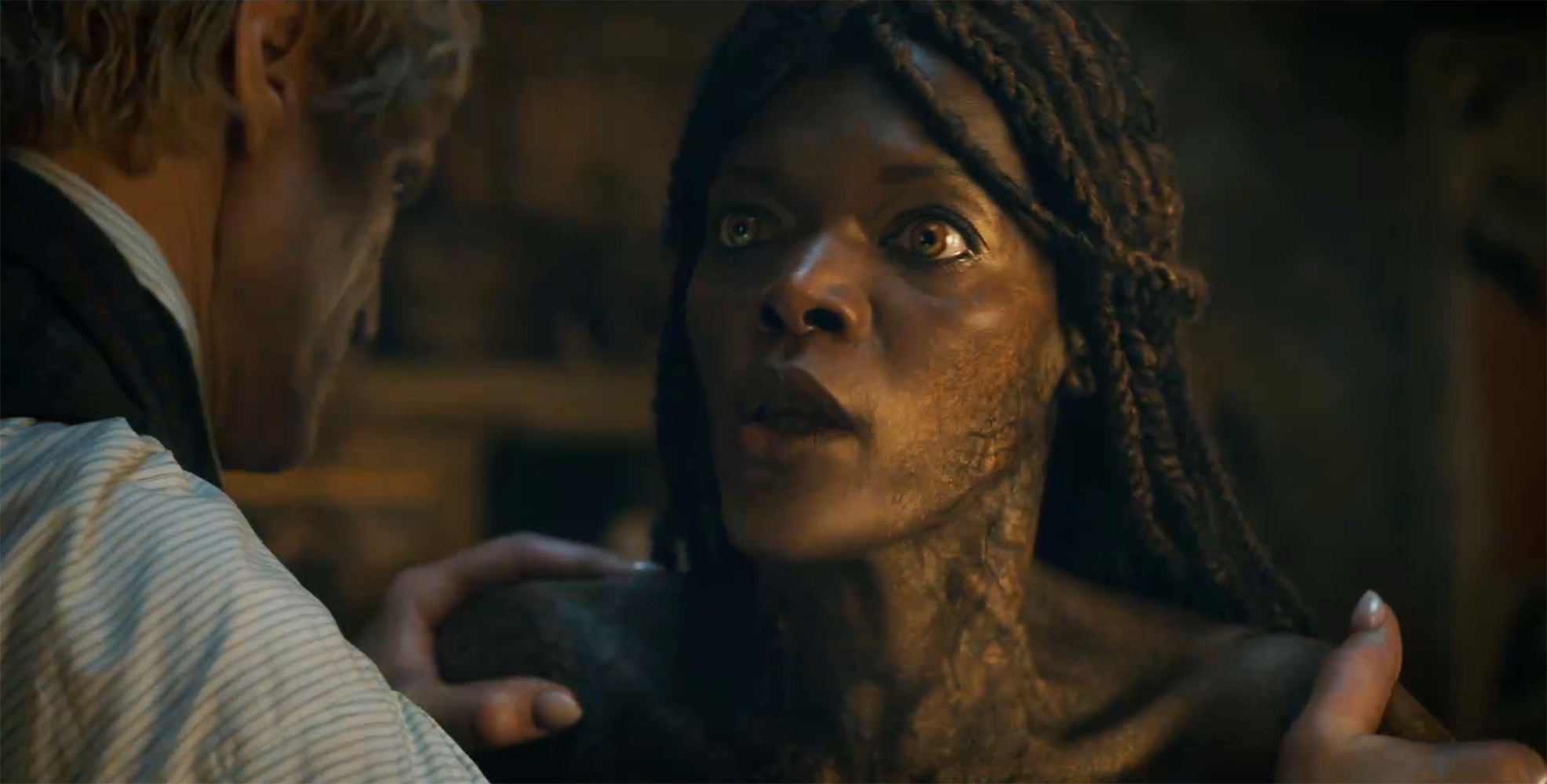
When Marius leaves on his vacation, Lestat is left in charge of Those Who Must Be Kept. One day he starts playing his violin, which awakens her.
She murmurs “come to me”, a callback that should rearrange your face, and then proceeds to drink from him. Then, for three days, she puppets his delirious body around the ceiling of the chamber while she rambles to herself, until Marius comes home to find his sacred, undisturbed-for-millennia ward wide awake and his new pupil dancing around the rafters.
Maybe you shouldn’t find your babysitters by digging them up from the ground?
We may not see much of Akasha awake here, but what we do, it’s already clear that she is an absolute powerhouse, as her booming voice rattles the room and shakes the very fabric of reality around us. Sheila Atim is going to break this show in half. The power radiates off her in waves the screen cannot fully contain, and to think this is only our first real glimpse of the Queen?!
Oh, I am so excited.
Confessions in a park
Back home in New York and technically kicked off the documentary but still working on it on his own, Daniel is conducting street interviews. One subject refuses to identify himself, and monologues vaguely about how “revolutions do not require a soundtrack,” mentioning he’s only turned one vampire, whom he followed as a human first for years, finding him “fascinating.” Daniel does not need long to clock who is actually speaking through this stranger’s face.
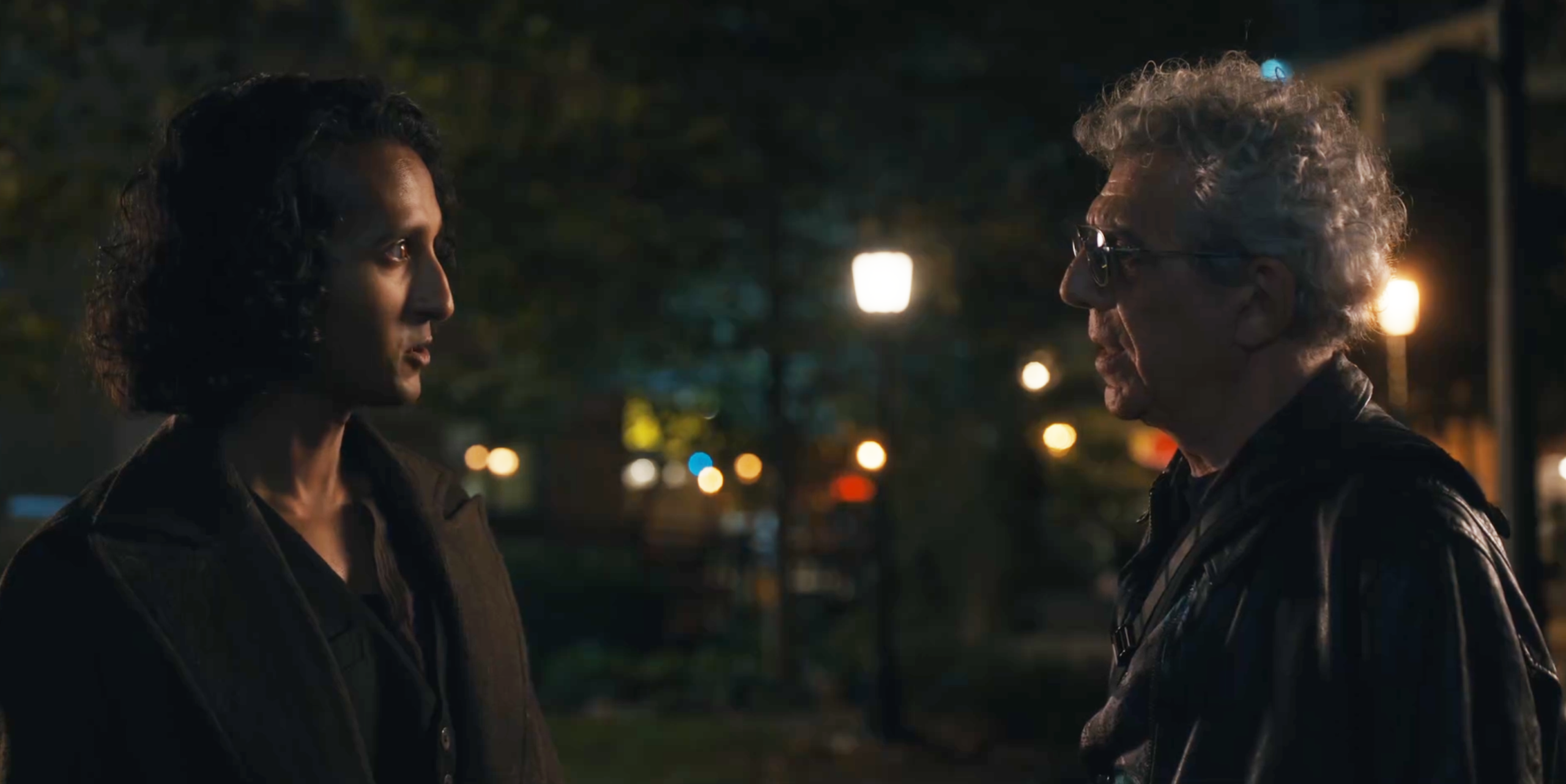
He finds Armand in a nearby park, and this time, Daniel is more receptive to talking.
What Armand confesses to is the last 52 years. In a beautiful speech, he tells Daniel he’s been watching him across the span of his life, intervening — getting the student Daniel slept with in a rental car safely home with no memory of the event, guiding Daniel to a chapel to be upset in private after his daughter forbade him from attending her graduation. And then going home to report it all to Louis like a man telling his roommate about his nightly walks.
But he has been Daniel’s invisible companion, and he has loved Daniel, by his telling, since some point along the way.
It’s a truly beautiful speech, some of the most beautiful writing on this show. I think it especially speaks to how the parts of Daniel that Armand has always been drawn to are likely not the parts that Daniel views as his most appealing, but which are the most human — and to Armand, those are the most beautiful of all (which I wrote about over here).
It is also very likely not the whole story.
Book readers have spent years hoping the show would eventually reveal something closer to Devil’s Minion as it exists in Queen of the Damned: not Armand quietly observing Daniel from afar, but the two sharing a long, chaotic relationship stretching over years — Armand kidnapping Daniel after their first meeting, chasing him across the globe, Daniel begging to be turned, Armand refusing, the two of them building a life on a private escape called Night Island in Florida together (give us our spinoff, AMC)…
Importantly, nothing Armand says here actually contradicts any of that. He says he watched Daniel for 52 years. That doesn’t mean watching is all he did.
I just don’t think there’s any chance this is the entire story, and I also wrote about why here. But look, the lack of a flashback to back up Armand’s words also suggests to me it’s even more likely to only be the part Armand is willing to give Daniel to “prove” his love right now. If he told Daniel the full extent of their past, and that he had meddled with more of Daniel’s memories, there’s no way Daniel is in a place at the moment to forgive him for that (plus, if Armand did remove those memories, how exactly does telling Daniel about memories he does not have prove anything? Daniel chose his words poorly here!).
To me, this feels like a beautiful introduction to Devil’s Minion rather than the full story of it, with the show deliberately holding back everything that happened in those missing years until it’s ready to reveal them. And of course they’re holding things back! If they exposition-dumped the entire thing into this scene, no one would be happy.
But I’m also going to be honest… separate from that, it took me a long time to get to a place where I really enjoyed this scene, because I wish we had more time this season to delve deeper into all of this. Because at the moment, it feels really rushed (Armand literally just re-entered the present timeline one episode ago, give or take 10 seconds at the end of episode three). All of the Gabriella additions this season have meant some characters, particularly Armand, have been pushed to the side a bit. And if the point of this is that Daniel must first fall in love with Armand or at least learn to trust him again, I want to see that.
Some of this season’s tell-not-show has worked masterfully, like burning Bruce off screen because it’s deliberately unsatisfying, or holding on Lestat’s face when he described Nicki’s death because he couldn’t look at the memory head-on. But here, I feel like we’re just rushing through this, and I want to see their dynamic, not just be told about it.
But I trust this writing team, so I’m willing to let the tale seduce me and believe we’ll be able to delve much deeper into all of this… later.
Anyway.
When Daniel starts to say that there’s no world in which he could ever love Armand, Armand sweetens the offer with two bombshells: one, that the woman calling herself “Sofia” is, in fact, Lestat’s mother, and they are sleeping together. Armand knows his boy never could resist a good story. Two, that he can give Daniel “half his life back” and give him back daylight hours by teaching Daniel how to daywalk (though that line, uh, has some other implications as well, in my opinion).
For a fledgling with the ancient blood of one of the most powerful vampires alive and approximately zero actual abilities to show for it at the moment, this is, as carrots go, an effective one.
And for Armand, this is the way he’s always done it. Love, wrapped in story, sweetened with just enough leverage to keep the other person from walking away.
Whether he is telling Daniel the whole truth here or only the version he’s willing to share for now, the result is the same. He’s got Daniel closer to where he wants him, which is by his side.
Breaks the circle
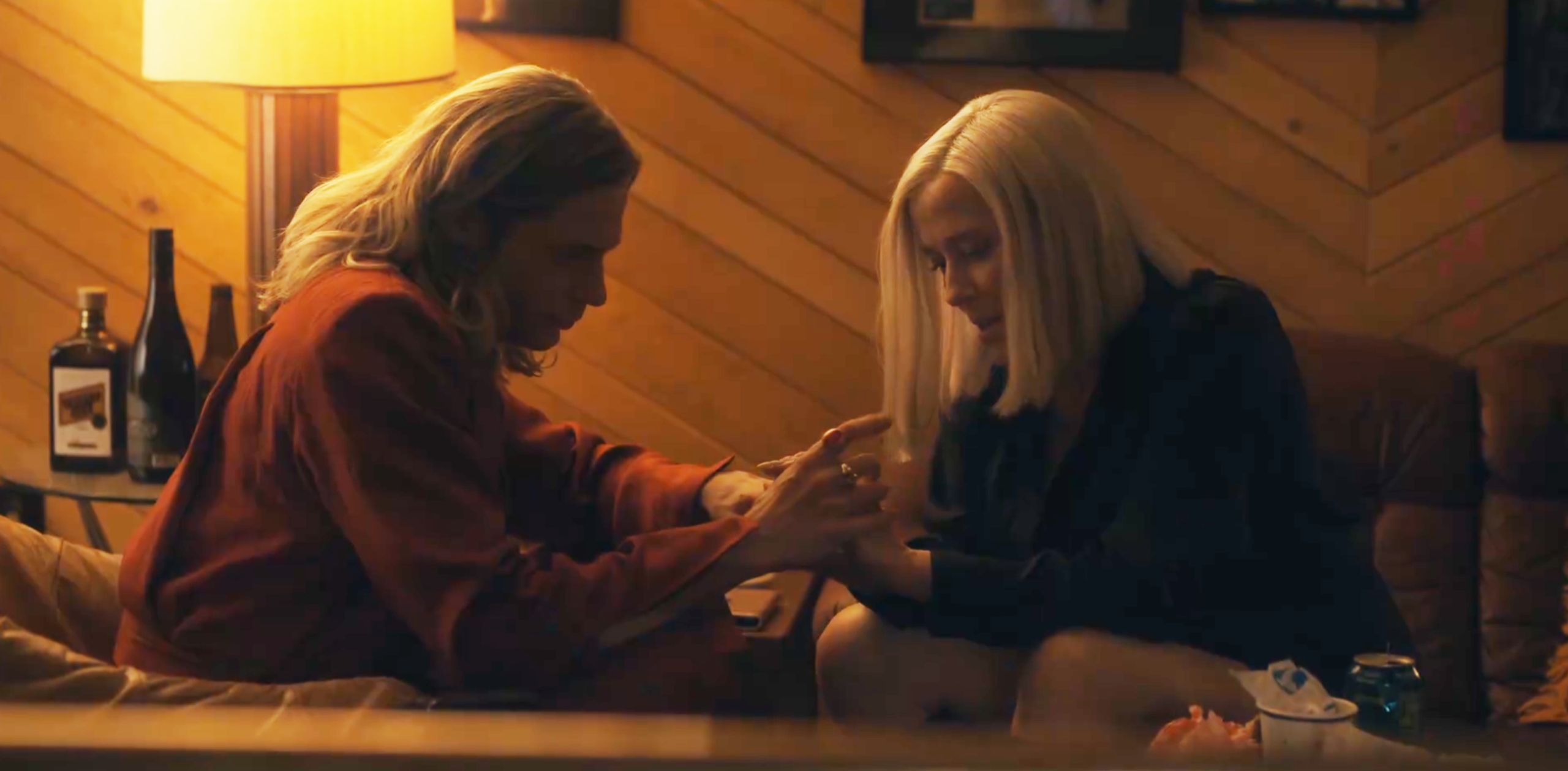
Back in the recording studio, Gabriella finally says the thing that explains their entire relationship, and reveals why she left (and keeps leaving, and will continue to keep leaving…).
“I did not need you anymore. You don’t need around you what does not need you anymore. Breaks the circle.”
It is the perfect distillation of who Gabriella is and why Lestat will never truly be able to keep her. Their love has always been transactional, and Lestat must continue to pay the emotional and physical tax in order to keep her in his life. He is constantly trying to earn closeness from her, to prove himself useful enough, devoted enough, interesting enough, wanted enough to keep her attention from drifting away again.
Which is why the conversation immediately turns physical, Lestat responding the only way he knows how to win her over, or that she has shown she responds to.
Even the song he is working on — the band repeating “make more, make more” like a mantra — is clearly an offering to Gabriella, as he asks if that “satisfies the request”. It’s again surely tied to the Great Conversion storyline running quietly underneath this season. Gabriella, knowingly or not, keeps teaching him that love is something you must pay for.
The unholy trinity
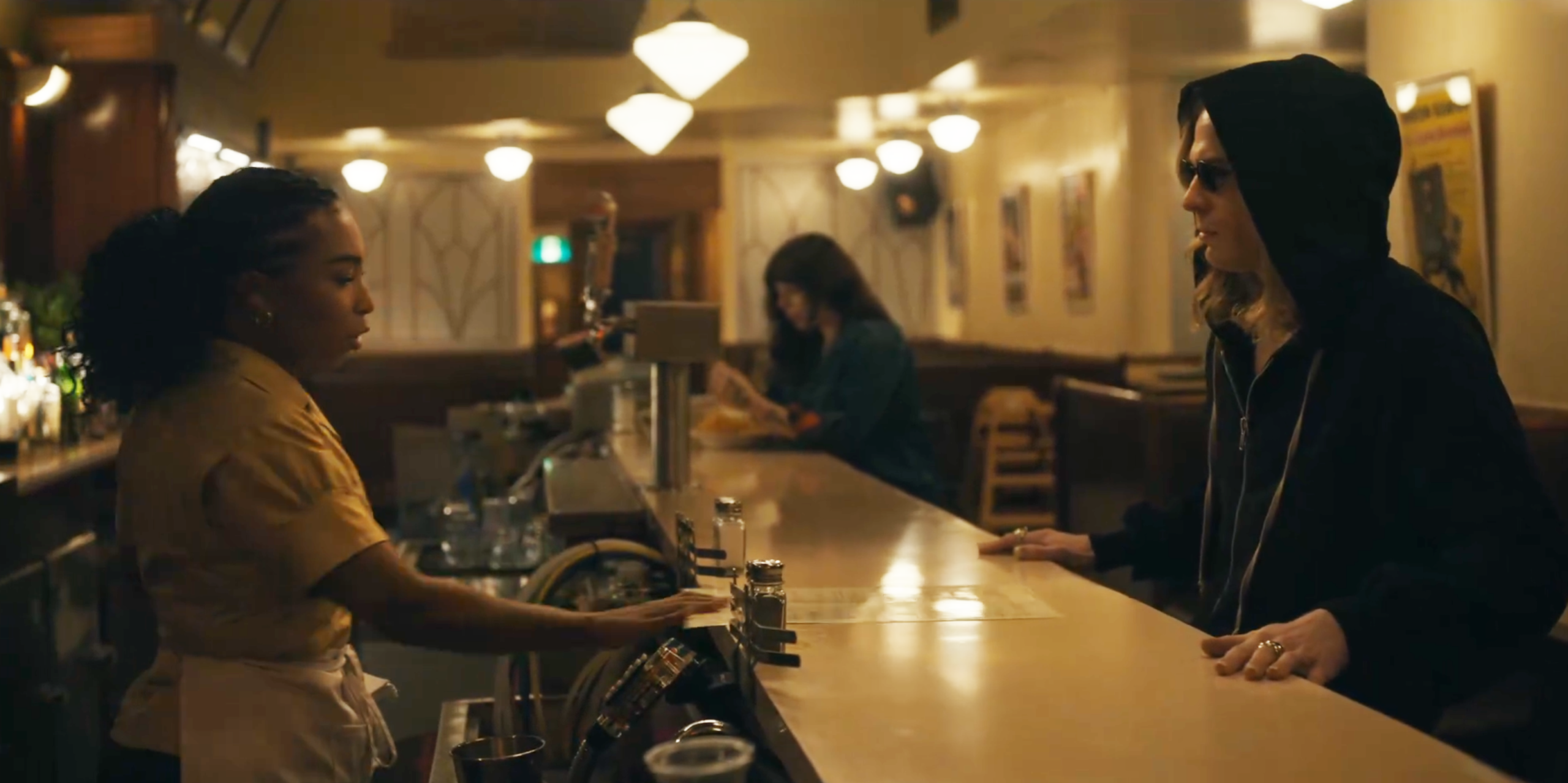
Meanwhile, Louis texts Lestat that he needs him. And Lestat, who has needed Louis all season long and has been reaching out, calling out, singing out, and received nothing in return, comes immediately.
Louis, currently trapped in his grief, is incapable of reaching back, and he’s starting to lose his already sometimes feeble grip on reality. He can no longer be certain that it isn’t really Claudia inside that diner. Could Lestat go and check?
Of course he says yes.
When Lestat meets Regina, there’s a small but incredibly effective moment between them. Regina recognizes him from Interview with the Vampire and from the band, despite the fact that Lestat is technically supposed to be dead. And though Lestat knows instantly that this isn’t Claudia, Sam Reid plays the scene with a visible jolt of grief at how much she resembles her. Reid and Delainey Hayles are both excellent, but Reid especially captures the impossible balance of being shaken by Claudia’s face while remaining completely focused on pulling Louis back from the edge of this fantasy.
Lestat returns to Louis and tells him what we already knew: it isn’t her. Different girl. Different life. Different soul.
I think Louis already knew that too. He just needed Lestat to be the one to say it.
There’s something more devastating about that. Lestat has to be the one to end the fantasy because he’s the only person who understands the shape of Louis’s grief. He’s the only other person who made Claudia, raised Claudia, failed Claudia, and has carried her absence as his own private wound for decades.
It’s also what makes Lestat such a sharp contrast to Gabriella this season. She may have shown up when Lestat called for her, but all she ever really offered him was her presence and an endless well of need. Lestat, by contrast, is trying to help Louis even when it hurts him, because he genuinely loves him. Unlike his mother, Lestat doesn’t leave the people he loves.
His problem has always been the opposite. He tries desperately to hold onto those he loves, and he will always come when you truly need him.

Stained Glass Eyes
The Regina encounter cracks something open in Lestat. He goes back to the studio and records a new track for Claudia, “Stained Glass Eyes,” a stripped-down, raw track that is nothing like what they have been recording for weeks. This, he tells the band, is what the album needs to sound like now.
“Stained Glass Eyes” is a devastating piece, and the first time since that shack in New Orleans at the end of season two that Lestat has been able to truly speak about his daughter. Earlier, with “Big Boss,” he was trying to recreate Claudia’s death through spectacle, chasing the sound of her final scream as though he could somehow manufacture his grief in that studio. It felt almost performative, another grand production in a life built around performance. But this is something entirely different. Here, Lestat finally simply allows himself to feel the depth of his grief.
This broken-down version of him is more honest than any of the larger-than-life personas he usually hides behind.
And that is what makes the moment hit so hard. This feels like the first version of himself Lestat actually believes is real enough to put into music without disguising it.
Daniel Hart delivers another all-timer piece of music here, and Sam Reid absolutely nails the performance. Every line carries the grief Lestat has spent decades trying to outrun, alongside all the love and guilt he still carries for Claudia. You can hear him mourning her in every line, but you can also hear him finally speaking to Claudia directly.
Larry takes one look at this version of the band and knows he isn’t going to be able to rise to this level. He has not been feeling great about his skills as a musician anyway, not helped by Lestat’s constant goading him all season long. So he quits, while the rest of the band stays, and asks to be turned into vampires.
The Gremlin is back
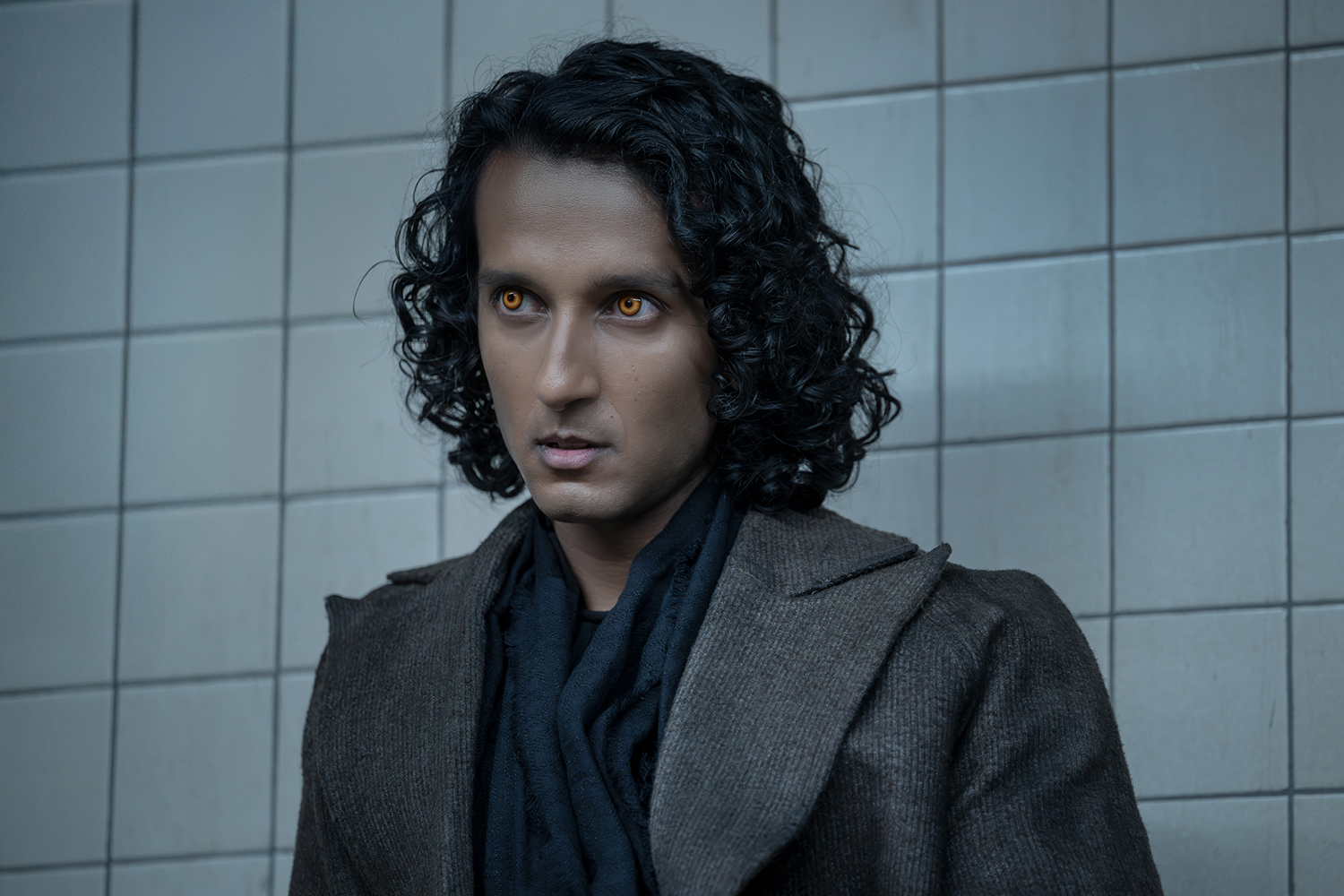
Larry, on his way home, gets recognized at a train station by a fan. He’s not in the mood, and as the train approaches, suddenly he isn’t alone. Armand is on the bench next to him, observing that Larry seems tired and he should “rest”. Then Armand, without any sort of fanfare, compels Larry to walk in front of the train.
Welcome back, Gremlin Armand. I’ve missed you.
There was no way that Armand wasn’t up to something this season, it’s always just been a matter of when the cards were going to start being laid on the table. This is a man who has to feel in control (because he spent so much of his life with none), and who thinks he knows the path forward and has never shied away from manipulating the scene around him if he thinks it’s going to help him survive. It’s also obvious that his main goal this year is stopping The Great Conversion.
What Larry’s death has to do with that, at the moment, is not entirely clear. Maybe Armand thinks dismantling Lestat’s band is the same as silencing Lestat’s voice (even though Larry had already quit the band). Maybe he is sowing discord among its members — if Alex in particular thinks Larry killed himself because Lestat essentially bullied him out of the band, then he’s going to blame Lestat in the end.
Maybe Armand is just annoyed about “Big Boss” (stay safe, Salamander).
How much of this season has been a carefully constructed performance, though? Is Daniel and his confession of love also just a chess piece on a board?
Other thoughts
- We had maybe 90 seconds of Sheila Atim and I am already so psyched for what she is going to bring to this show.
- The way that the room shakes while Akasha is awake is very reminiscent of episode one this season, when Lestat began to play his violin after having visions, and the concert seems to quake. That is definitely not a coincidence.
- The scoop from the intro being an ice cream scoop Lestat found at a merchant in town and is excited to show Akasha is legitimately hilarious. As pointed out by Pop Culture Weasel on Twitter, it is also a nod to the Samuel Beckett play, Krapp’s Last Tape. I also love how Sam Reid is playing this younger, less hardened version of Lestat, who has far more whimsy left in him.
- I also love the juxtaposition of how easy it was for Armand to get Larry to walk in front of the train, compared to when he was trying to convince a young Daniel Molloy to “rest” in San Francisco. It truly speaks to just how strong Daniel’s mind must be, as he was actively arguing with Armand that he didn’t want to die.
- Daniel Death Watch: Nothing much to note here this week, but I am still on high alert and still insistent that something is very wrong with Daniel Molloy, even if Armand thinks he can teach him to daywalk (and, I would like to say, I don’t feel that discounts my theory from last week. Tolerance, after all, simply means you need more of something, so maybe drinking more of Armand’s blood is going to at least temporarily be good for Danny Boy Molloy). But even if I’m wrong on the specifics, there is something very, very wrong with Daniel.