Note: There are book spoilers for The Vampire Chronicles, so read at your own risk if you don’t want to be spoiled for possible plot points.
The new season of The Vampire Lestat premiered this evening, and while it’s not a total reinvention of itself, it’s certainly playing in a different key. To match the gleefully, ferociously wild words in Anne Rice’s sequel novel of the same name, showrunner Rolin Jones and his team have re-tuned the series to be something new entirely. This version sees the vampire Lestat de Lioncourt (Sam Reid) embarking on a rock-and-roll tour, all while trying very hard to outrun several centuries’ worth of regrets, consequences, and failures.
It’s interesting, then, that we open not with the tour, the band, or even with Lestat himself on stage, but rather something that I think is much, much further into the future. And it’s arguably the boldest decision in this episode, which is saying something.
So let’s begin in the middle
The season opens at a clandestine auction, attended by wealthy individuals, where the lots up for bid are the culmination of Lestat’s entire life: his complete music catalog, his master recordings, and a 111-volume self-recorded chronicle titled “The Failures”.
Lestat himself narrates the opening of the recordings, the way an audiobook intro might. “If you are hearing this now, you must be a very privileged individual,” he croons — not to us, but to whoever wins the auction. We’re listening to a conversation Lestat is having directly with a future buyer he can’t see and won’t meet (theoretically, anyway, but we’ll get there).
The whole season opens with Lestat already in the past tense.
“So let’s begin in the middle,” he says, and in doing so, immediately establishes that everything we’re about to watch — the tour, the documentary, the version of events he’s presenting to the world — is not the present day. Unlike the Dubai interview in the first two seasons of Interview with the Vampire, which unfolded in real time, The Vampire Lestat appears to be looking backward.
The question is simply how far backwards we are going. And whatever Lestat is about to walk us through, he has already survived it. Or at least, some version of him has, at least for a time.

Some major shit went down
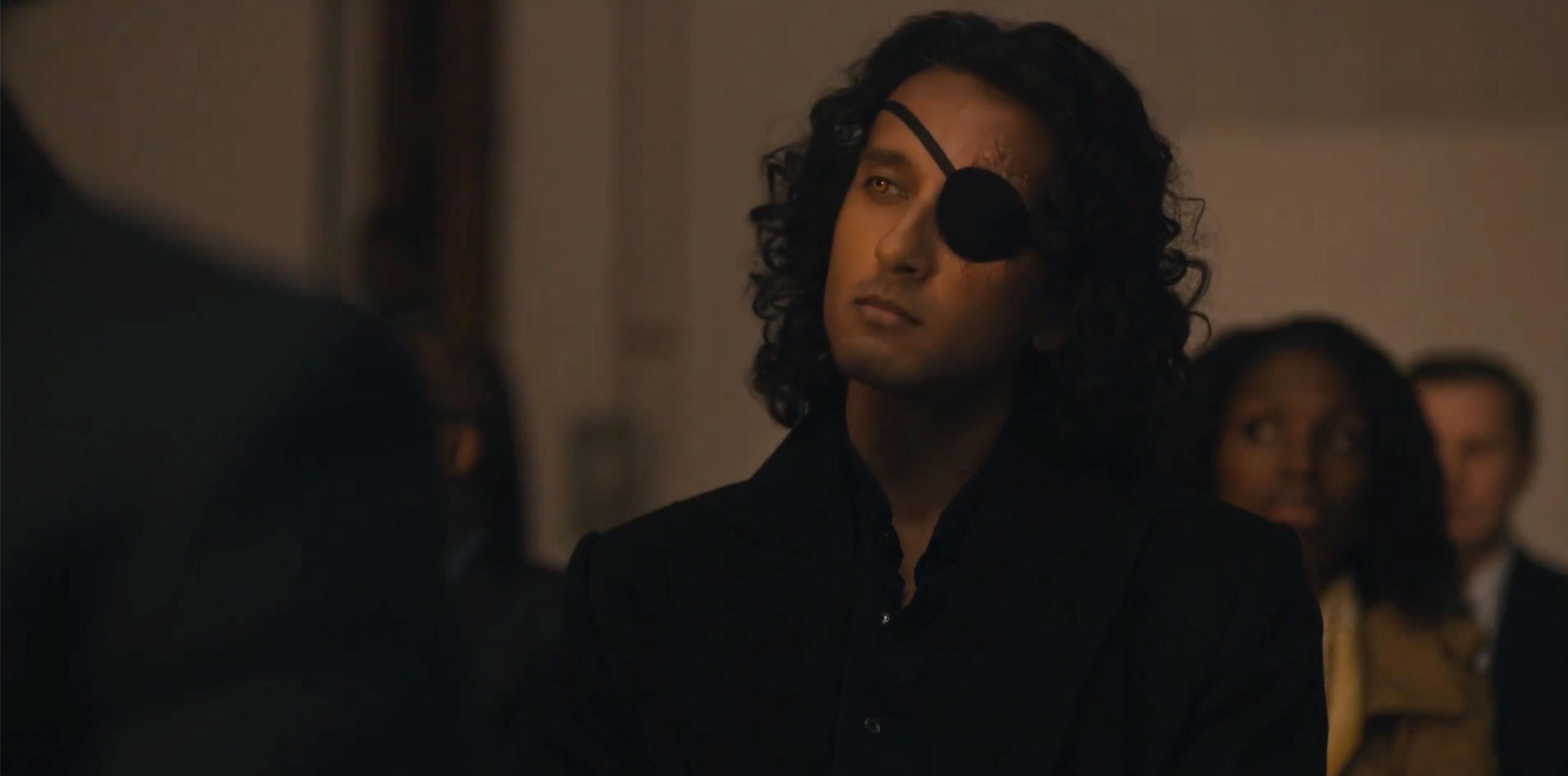
It’s immediately obvious that whatever has happened between “the middle” and the actual present day was definitely not good. Armand (Assad Zaman) is missing an eye. Louis (Jacob Anderson) arrives with a noticeable limp, apparently having lost his leg.
Vampires don’t easily lose body parts. Whatever happened before this auction room, it was bad enough to leave permanent marks on two of the most powerful immortals on this series (and Armand is, as of now, the most powerful vampire we’ve seen to date).
[Side Tangent: Armand losing an eye feels like a nod/shift from Lestat losing an eye in Memnoch, possibly in his place. Now, I’m less convinced the literal Devil is going to take the eye from him as he did to Lestat in that book — but rather, I feel like it might be a play on one of my favorite unhinged Armand moments in the books, when, after seeing Lestat has lost said eye, offers to rush out and pluck him a new one to gift him with. From The Vampire Armand book: “Let me go down into the streets, let me steal from some mortal, some evil being who has wasted every physical gift that God ever gave, an eye for you! Let me put it here in the empty socket. Your blood will rush into it and make it see. You know. You saw this miracle once with the ancient one, Maharet, indeed, with a pair of mortal eyes swimming in her special blood, eyes that could see! I’ll do it. It won’t take me but a moment, and then I’ll have the eye in my hand and be the doctor myself and place it here. Please.” Maybe here in the show’s version, Armand will sacrifice his eye in some big battle to try to protect Lestat, thereby literally giving him the eye he offered in The Vampire Armand. But that’s not what we are here to discuss!]
There are two characters conspicuously not in the auction room: Daniel Molloy and Lestat himself (at least in his usual form… again, more on that in a moment). I’m much less worried about Lestat, but given Baby Jenks’ ominous “Oh, he dies bad” about Daniel later in the episode, I think there’s genuine reason to have Danny Boy Molloy on death watch (but please let this be a red herring, or the show’s version of retconning Armand’s death in the books).
But back to the present — or rather, the past. First, let’s talk about what Lestat himself says happened.
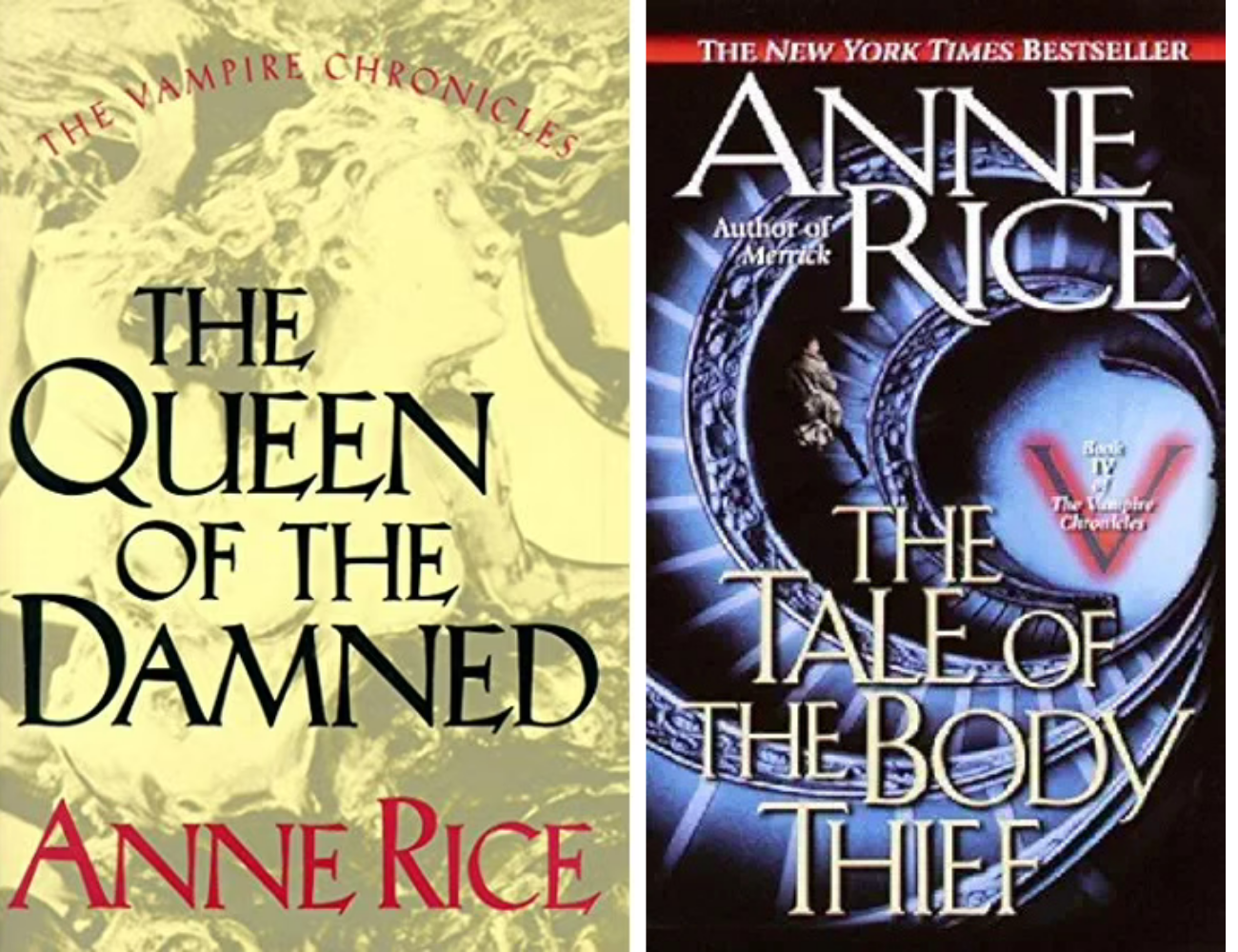
We’re way past Queen of the Damned
A lot happened this episode, so you’re forgiven if you missed some of the finer details in this intro. But Lestat laid out both the plot and the timeline for you: “I could and should have ended it there,” Lestat says on his recording. “My tour, my hedonistic pursuit of extremity, all of it. And had I done so, the regretful dead and the traumatized still alive would be somewhere other than they are today. And I am not saying that the attempted extinction of the Y chromosome across the continents was all my fault. No, that would suggest a level of self-importance even I’m not comfortable with. But, upon reflection, yeah, a contribution.”
The “attempted extinction of the Y chromosome across the continents” is one of the most spoilery throwaway sentences this series could have dropped in this cold open, but it’s also very clearly a roadmap for where we’re headed — which is straight into (and past) Anne Rice’s Queen of the Damned, the third novel in The Vampire Chronicles series.
That novel picks up directly after The Vampire Lestat, when Akasha, the original vampire and the titular Queen of the Damned, wakes from her centuries-long sleep and decides the world’s problems can be solved by killing nearly every man on earth. She might not be wrong, depending on your viewpoint of men’s contribution to the planet… but she’s definitely not, uh, subtle about it.
When Lestat casually references an “attempted extinction of the Y chromosome,” it’s hard not to see Akasha all over that line. For book readers, it immediately tells us the auction is taking place after Akasha’s rise and fall, after the events of Queen of the Damned, and after whatever consequences those events leave behind. It would certainly explain why Louis is injured, why Armand is missing an eye, and why Lestat speaks about this era of his life with the benefit of considerable hindsight.
Realistically, there’s almost no chance we’re reaching those events by the end of this seven-episode season. There’s simply too much of The Vampire Lestat to cover first. But Rolin Jones, Hannah Moscovitch, and others involved with the series have repeatedly described this adaptation as a two-part story, much like Interview with the Vampire before it — it’s just that, in my opinion, part two is clearly going to be Queen of the Damned.
The two books have always been spiritual bookends to me. While The Vampire Lestat deals primarily with how Lestat became a rock star, much of The Queen of the Damned deals with the vampires of the world converging upon a concert of his in San Francisco, where some serious shit goes down, and then the fallout of that. If The Vampire Lestat is lighting the match, then Queen of the Damned is watching the fire spread. It’s not hard to see how those two books make sense to be connected into one more cohesive, two-season storyline. There are already signs of it, with elements of that third novel (like the inclusion of Baby Jenks) already woven into the plot from the start.
Viewed through that lens, it makes perfect sense to treat them as a single larger story. And if this opening scene is any indication, the show may already be telling us exactly where that story ends.
And then there’s Raglan James
As I keep alluding, Lestat wasn’t in that auction room… at least, not in his usual form. Book readers also know that in The Vampire Chronicles, there is another novel that this cold open could easily be pointing towards.
The Tale of the Body Thief is the fourth book in the series, and its premise is exactly what it sounds like. A psychic con artist named Raglan James (who in our TV universe is a member of the slippery Talamasca organization) convinces Lestat to swap bodies with him for a brief period. Lestat agrees, because Lestat is, as we are well aware by now, an absolute disaster who cannot resist a bad idea. Raglan, predictably, takes Lestat’s immortal vampire body and runs away, leaving Lestat trapped in a mortal human one and forcing him to chase Raglan across the world to get his own body back.
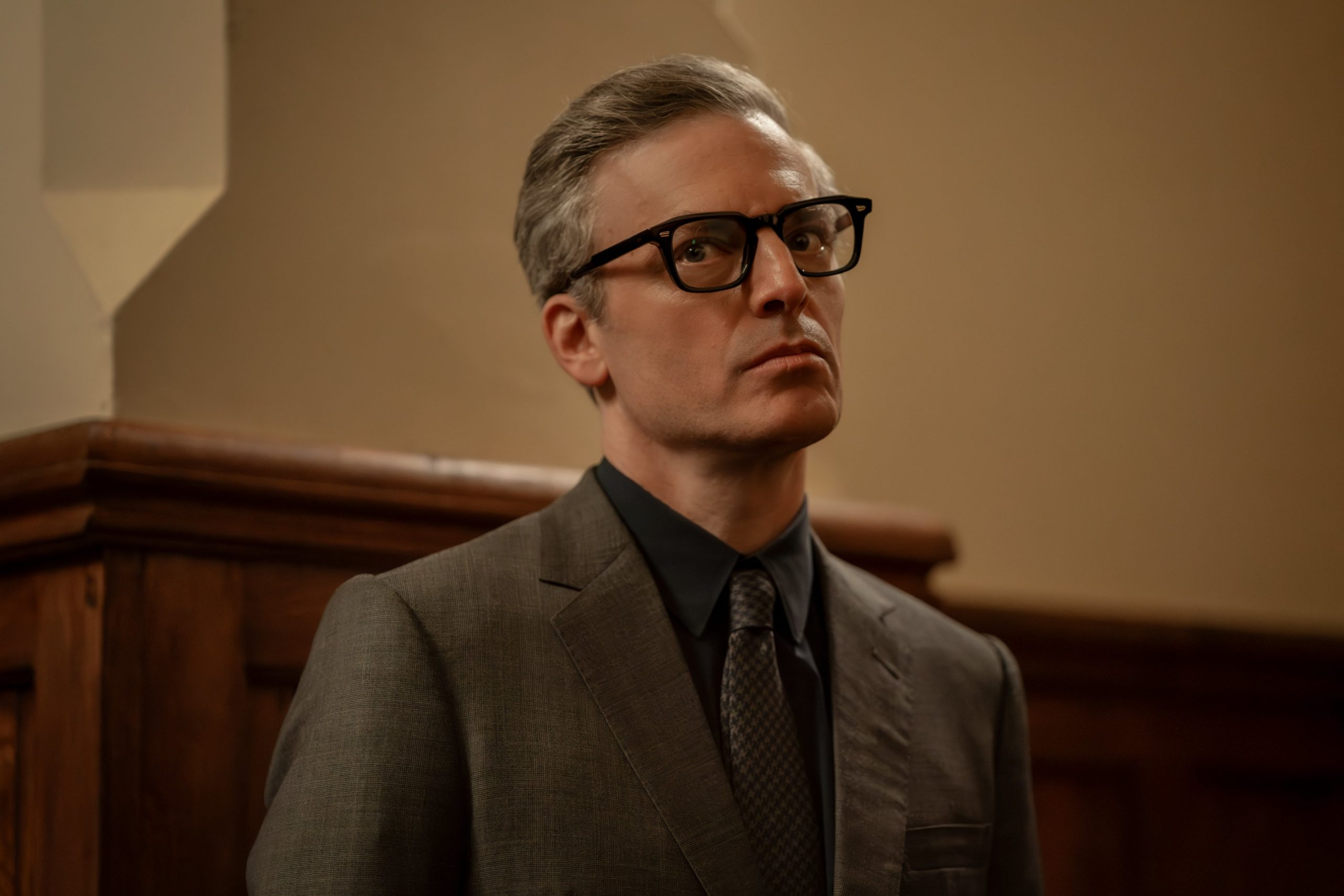
Why am I telling you all this? Because Raglan James is in the auction room, and he’s being weird with a capital W. Several of his mannerisms feel very Lestat-like, and very unlike the Raglan we’ve seen to date.
For non-book readers, his presence is likely just a blip on your radar — after all, he’s been lurking around the edges of this series for two seasons already, so it’s not weird that he’s wound up here at the auction as well. But for book readers, his presence sure feels like a signal that this open is not just setting up the events of Queen of the Damned — it’s likely headed past even that.
So the question of why Lestat isn’t physically in the auction room may have a very specific answer: he might not be in his own body anymore.
(I also think that both Lestat’s doppleganger Jarda and that bottle of blood in the auction are going to come into play in very big ways if there is some body swapping going on. Perhaps Jarda ultimately dies in Lestat’s place so Lestat can fake his death, and he has body swapped with Raglan so he can still be around without the fame he brought upon himself? Or perhaps Lestat dies, but they’re ultimately able to swap him back into Jarda’s body, and re-imbue him with his powers via the bottle of blood? Maybe that blood ties back to healing Armand’s eye, as that quote from The Vampire Armand implied. I don’t know and this is why I don’t get paid the big bucks, but I can at least recognize those are both very important elements the show is setting up for later. Much, much later.)
(But also, please don’t kill Daniel Molloy, guys.)
The horizon
I truly think this opening is either meant to be the very end of season four, or the very start of season five [Editor’s Note: After time of publication, Rolin Jones confirmed to IGN that the opener is “almost a season and a half ahead”].
It’s an incredibly ballsy and confident move by Rolin Jones and his team to not just kickstart this season with the tonal equivalent of a key change — yanking us out of the Dubai-interview register entirely and dropping us into something rawer, stranger, and more chaotic — but also to signal that this show has a clear vision for what’s ahead, all the way out.
Most prestige shows are reluctant to show their hand this early. The current TV landscape has been actively training shows not to make promises; too many series get cancelled before their planned endings, too many audiences have been burned by shows that didn’t know where they were going. For me, it’s possibly the boldest choice in an already over-the-top, balls-to-the-walls, episode of television.
It almost feels like a dare to the suits at AMC. We know where we’re going. Get out of the fucking way and let us get there.
Now that is a rock star move.